
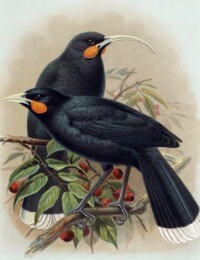
Huia: a handsome, dark, velvety bird.
24th Jun 2023 - Blog
There is a recording out of a very fine song and performance, The Huia and the Magpie, performed by Tāmira
Whilst translating Johann Christian Hüttner’s account of the Macartney Embassy to Peking in the 1790s, (more info). I came across his description of the place in Macao where the Portuguese soldier and poet Luis Vaz de Camōes had supposedly written his epic The Lusiads (Os Lusíadas), later published in Lisbon in 1572. Intrigued, and not knowing of Camōes or his poem, I followed the trail to find that many travellers to Macao, before and since, had noted the same site and knew of the poet and the poem, and many had sketched and painted the now very romantic site – a grotto, cave or seat. There was an 18th century English translation available, and that other romantic writer and traveller Sir Richard Burton, later in the 19th century, contributed with his own translation, commentary and a life of the poet. Modern translations are available.
All cultures seem to have their epics, stories and poems of the wanderer and explorer – Homer, Virgil, Camōes, through the 18th century English picaresque novels, Goethe’s Werther, Don Juan, and the poetry of exile such as that of the great Tang poet Tu Fu. A recent fine book on Camōes and his contemporary Damião de Góis (Wilson-Lee, E., A History of Water: Being an Account of a Murder, an Epic and Two Visions of Global History. London, Collins, 2022.) has added to the interest, and so here is a piece on Camōes and Macao.
24th Jun 2023 - Blog
There is a recording out of a very fine song and performance, The Huia and the Magpie, performed by Tāmira
17th Dec 2022 - Science and Thinking
It was always going to be biology, and being a farm boy, animals and plants were in the mix. So,