WASC: War Area Services Corps Diary for 1946. China
The year 1946 was a Chinese year of the dog, and, as written in one of the War Area Service Corps (WASC) pamphlets for personnel of the American and other foreign forces, the dog represents fidelity. It is one of the softer symbols of the zodiac, Yin rather than Yang, a little darker, and more passive, and the editor of the pamphlet, H Y Lowe, reaches out to his Western readers with an awkward canine anglicism: ‘A Happy “Gay Old Dog” Year throughout these twelve moons’. Such also was the tone of the WASC diary for 1946.
The WASC was formed in 1937 by Chiang Kai-shek, and through the 1940s provided hostels, entertainment and services to foreign, mainly American, servicemen. In 1945 and 1946 it published a series of pamphlets on China and things Chinese, on topics including Chinese philosophers, festivals, literature, dogs and the New Life Movement. The WASC and its publications was taken over later that year by the Officer’s Moral Endeavour Association (OMEA), an organisation established earlier by Chiang and his wife Soong Mei-ling in the 1920s as part of a drive for moral regeneration among the services, with Confucian principles of service, wholesome living and obedience.
The pamphlets are informative, easy to read, bridge the China-Western divide, and are laced with the programme of the OMEA with its themes of looking forward, resilience, and a wholesome, moral way of living and service. Some eleven of these pamphlets have been described and can be read about in detail here (https://ianferg.nz/allied-friends-welcome/).
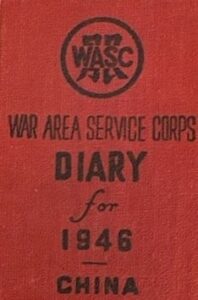
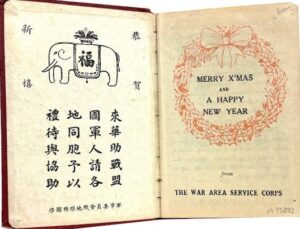
One of the WASC publications in the 1940s was a regular diary. In red cloth, 8.5 x 13 cm (the original ’little red book’?) it contains a planner for the calendar year, with much else. The copy at hand is pristine, still to be used, and a real delight. On the inside cover is Chinese text with the symbol of an elephant, the animal common in designating peace, good fortune and stability, appropriate for the country emerging from WWII and the Japanese invasion.
The text with the elephant provides a general message echoing the seasonal greeting on the opposite page, and a directive on how the Chinese should treat Allied soldiers. The four characters surrounding the elephant provide wishes for the New Year, the character in the blanket good fortune or happiness, and the vase on the beast’s back is a traditional sign for peace. The main message on the page is a request for Chinese citizens and the military to treat allied forces with respect and hospitality since they have come to help in the war effort.
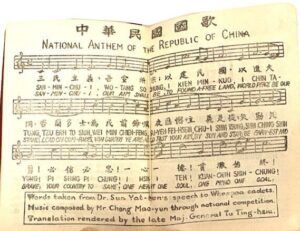
On the next page is a copy of Sun Yat-sen’s political will. Sun left three documents, a personal will, a political will, copied here and signed on March 11, 1925, the day before he died, and a final letter to the Soviet Union. This political will records his forty years of devotion to the revolution, but ‘The work of the Revolution is not yet accomplished. Let all our comrades follow my Plans for National Reconstruction, Fundamentals for National Reconstruction, Three People’s Principles, and the Manifesto issued by the First National Congress of our Party…….This is my heartfelt charge to you.’ Then follows six pages of Some Salient Facts About China, including notes on history, Government, Kuomintang, the Youth Corps, Finance, Military, Religion, and China’s Aspirations. And for all to sing, the National anthem, using words from Sun’s speech to Whampoa cadets.
Next comes a one page speech from Chiang, The Generalissimo Speaks: October 10, 1944, noting that the republic is 33 years old and has resisted ‘a powerful aggressor for more than seven years.’ He ends speaking directly to his foreign supporters: ‘No matter how the situation may develop in the future, we shall continuously maintain our friendship with our Allies, and discharge our responsibilities as a member of the United Nations in a spirit of mutual assistance and cooperation.’ There is information on the WASC, a list of dates to remember, including Lincoln’s birthday and the day to remember Pearl Harbour. There were only five more years before Chiang was defeated in October 1949, followed by his departure for Taiwan, along with the policy of friendship with America.
The rest of the booklet is comprised of the calendar and planner, designed with one week across two pages. At the end is a list of Chinese Dynasties, conversion tables, popular Chinese dishes, advertisements for restaurants, hotels, banks and shops, ending with a page of Pointie-Talkie (in case of a pinch) of common phrases: Please get me a doctor, Can you hide me?, How much is this?, Thank you, with the Chinese script on the opposite page. The final words, in English and Mandarin, are: yes, have, can, no, have not, cannot, somehow pointing to the uncertainties of the immediate years ahead.
The diary is a treasure, and a small capsule of time.