Some times when reading a travel account or diary you are brought up short. Here is the 12-year-old George Thomas Staunton writing in his diary for Monday March 11, 1793, in Batavia (now Jakarta on the island of Java, Indonesia)
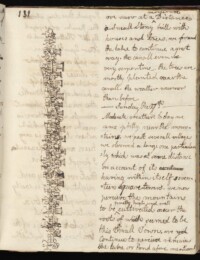
“Monday the 11th
This morning we went to see Mr Titsingh. He showed us some very curious Chinese and Japanese coins of gold, silver and copper. All the copper ones have a hole in the middle for the convenience of stringing them. One of these copper ones with the sign of the Zodiac marked on it. Mr Titsingh was so good as to give me a Japanese writing box. This Evening Lord Macartney went aboard. Soon after we went to the Play. The Play was called the Barber of Seville in four acts. There were no actresses, but in the room of them some of the actors there Dressed in Women’s cloaths. The Singing and Scenery were Pretty good. At the end of the Theatre is a large Box for the Gentlemen of the counsell only.”
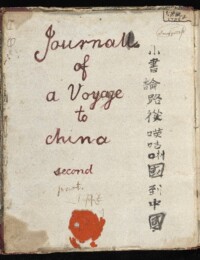
The young George Thomas Staunton accompanied his father Sir George Leonard Staunton, second in command to Lord Macartney, on the British Embassy to the Qianlong Emperor in Peking, in 1792 to 1794. This diary covers the departure from England through to sighting Cochin China (Vietnam), before proceeding on to China. The Embassy stayed in the vicinity of Sumatra and Java for some time, including going ashore at the Dutch colonial capital of Batavia in Java, and being entertained extensively by the Governor (Willem Arnold Van Alting) and other members of the Governor’s Council, including Mr Van Weegerman with whom they stayed.
The Dutch lived in style. If we go back a few days (Friday 8th), Staunton says:
“Our host gave us a very splendid entertainment before and after Dinner. His slaves of which he has about eighty brought us water to wash our hands. At Dinner near each plate was a saucer full of rice to eat instead of bread if we liked it. In the Evening we went to a Ball at the Governors country house, which is to celebrate the Birthday of the Prince of Orange. The whole of the governor’s garden was illuminated with lamps. In the house there were a great many ladies with their female servants sitting cross legged before them.”
Sir John Barrow, Comptroller of the Embassy, (and Mr Barrow at the time) in his account of the voyage out[1], provides even more details of Dutch colonial splendour in these first days of going ashore in Batavia.
“On our first visit to Batavia, we were received with great ceremony at the gates of the castle by the old Governor Van Alting, accompanied with the wel edele heeren [high ranking administrators of the Dutch East India Company, VOC], composing the Council of India. On this occasion we all suffered greatly from the heat of the climate. It happened to be about the middle of the day, when the sun was vertical, and not a breath of wind stirring; the mercury in Fahrenheit’s thermometer at 89° in the shade; when, after abundant ceremony in the open air, we were introduced into a close narrow room, with a couple of windows at one end, nearly filled with fat “sleek-headed men,” dressed in suits of velvet stiffened with buckram. In this narrow room, and mixed among these warmly clad gentlemen, we were seated round a table covered with crimson velvet, on chairs whose corresponding cushions were stuffed with feathers. And though the very appearance of the furniture alone was enough to induce a fever, two or three little chafing-dishes with live coals were set on the table, for the accommodation of those who were inclined to smoke a pipe of tobacco, which, with wine, spirits, and cakes, were handed round to the company.
The ceremony of our introduction being ended, we proceeded from the castle to the country house of Van Weegerman, the second in council, to which we were conveyed in small carriages, each drawn by a pair of ponies, and driven by a black coachman, who, mounted on a high box, with a large three-cornered hat and an enormously long whip, formed no unimportant part of the equipage. The distance we had to travel was only about a mile beyond the city gate.”
And a page later:
“We had scarcely set foot in the house when a procession of slaves made its appearance, with wine and gin, cordials, cakes and sweetmeats; a ceremony that was repeated to every new guest who arrived. After waiting a couple of hours the signal for dinner was given by the entrance of three female slaves, one with a large silver bason (sic), the second with a jar of the same metal filled with rose water for washing the hands, and the third with towels for wiping them. The company was very numerous and, the weather being remarkably close, the velvet coats and powdered wigs were now thrown aside, and their places supplied with short dimity Jackets and muslin night-caps. I certainly do not remember ever to have seen an European table so completely loaded with what Van Weegerman was pleased to call poison and pestilence. Fish boiled and broiled, fowls in curries and pillaws, turkies and huge capons, joints of beef boiled and roasted and stewed, soups, puddings, custards, and all kinds of pastry, were so crowded and jumbled together that there was scarcely any room for plates. Of the several kinds of dishes there was generally a pair: a turkey on one side had its brother turkey on the other, and capon stared at capon. A slave was placed behind the chair of each guest, besides those who handed round wine, gin, cordials, and Dutch or Danish beer, all of which are used profusely by the Dutch under an idea that, by promoting perspiration, they carry off in some degree the effects of the poison and pestilence. After dinner an elegant desert was served up of Chinese pastry, fruits in great variety, and sweetmeats. There were not any ladies in company.”
Given all this, who would be surprised that the Englishmen should be entertained with a performance of The Barber of Seville. What were they watching? Clearly not Rossini’s famous opera, written later in 1816. The original subversive comedy was written by Pierre Beaumarchais in 1777 and widely performed. The only operatic version prior to 1793 was by the popular Italian Giovanni Paisiello (1740-1816), written in St Petersberg in 1782, where he was court composer to Catherine the Great. Pasiello was one of the most popular opera composers of the time, and Mozart met him in Italy in 1771, and wrote his own version The Marriage of Figaro in 1786 with the libretto my Lorenzo da Ponte. Other operatic versions of the play by Nicolas Isouard (1796), Samuel Arnold (1794), and Francesco Morlacchi (1816) were too late for the Batavia performance. While it is more probable that that they were watching a performance of Beaumarchais’ play, it might have been an amateur operatic performance because of Staunton’s note that the singing was ‘pretty good’, and the performance in four acts. Both Beaumarchais’ play and Paisiello’s opera have four acts. There are no records of professional opera in Batavia until later in the early 19th C, and it seems the English were watching a local, amateur performance, with men taking the female roles. Women players and singers were common in Italian theatre and opera through the 18th C, so the Dutch of Batavia either kept their women away from the glare of the footlights, or their voices weren’t good enough.
The Barber was not the only entertainment available in Batavia for the Embassy. Aeneas Anderson, Macartney’s valet who wrote his own account of the Embassy, published in 1797 just before the official account by Sir George Leonard Staunton, writes for Wednesday 13:
“In the evening I went to see the tragedy of Mahomet, and paid a rix-dollar for admission. The theatre is situated in the middle of large garden, which is a place of public resort for the Batavians of every rank and denomination. It is a spacious brick building, decorated with great elegance, and fitted up with front and side boxes, and galleries; its orchestra also contained a tolerable band of music.
The play, as far as I could judge, from the attitudes of the actors, and the expression of their countenances, for the whole was in the Dutch language, was very well performed. The entertainment was Barnaby Brittle, and afforded a great deal of amusement.”
Mahomet was probably a dutch translation of Voltaire’s controversial Le fanatisme, ou Mahomet le Prophète), written in 1736. Barnaby Brittle was the two-act farce Barnaby Brittle; or, A Wife at her Wit’s End, commonly performed in London at the time.
One other note of interest. Staunton mentioned meeting Mr Titsingh in Batavia. Isaac Titsingh (1745–1812) was a high ranking figure in the Dutch East India Company (VOC), based in Batavia and mainly associated with trade and diplomacy with Japan, but led a Dutch Embassy to the Qianlong Emperor in 1794, the year of Macartney’s return. His deputy on the mission was the Dutch merchant Andrea Everadus van Braam Houckgeest (1739-1801), who published an account of the embassy in 1797 (in French), translated into English in 1798.[2]
Both childhood diaries of George Thomas Staunton from the Macartney Embassy to China, September 1792 to May 1794, have now been transcribed and posted, courtesy of the David M. Rubenstein Rare Book & Manuscript Library, Duke University, North Carolina. The most recent is the first, from their departure in September through to May 1793 where they are in sight of the Cochin China (Vietnam) coast (https://ianferg.nz/the-diary-of-george-thomas-staunton-during-the-macartney-embassy-to-china-15-sept-1792-17-may-1794/). A diary from that date until the 30 August 1793 when the Embassy had reached Peking is missing. The second diary covers September 1793 through to their departure from Canton in February 1794 , and includes the meetings with the Qianlong Emperor both in Peking and Jehol. (https://ianferg.nz/young-george-thomas-stauntons-diary-of-the-british-embassy-to-china-part-2-30-august-1793-1-february-1794/)
The first diary now posted is surely worth reading for the wonderful opening lines alone:
“This Morning my Papa, Mr Hüttner and myself in one chaise, and the two Chinese in the other, and a servant riding behind, set out on our Journey to China.”
[1] Barrow, J. A Voyage to Cochinchina, in the Years 1792 and 1793: Containing a General View of the Valuable Productions & the Political Importance of this Flourishing Kingdom; & Also of Such European Settlements as Were Visited on the Voyage: with Sketches of the Manners, Character, and Condition of their Several Inhabitants. To which is annexed an Account of a Journey, made in the Years 1801 and 1802, to the Residence of the Chief of the Booshuana Nation, being the Remotest Point in the Interior of Southern Africa to which Europeans have hitherto penetrated … London: Cadell and Davies, 1806. pp204-206.
[2] Houckgeest B. An Authentic Account of the Embassy of the Dutch East-India Company, To The Court of the Emperor of China, in the Years 1794 and 1795; (Subsequent to that of the Earl of MacCartney). Containing a description of several parts of the Chinese Empire, unknown to Europeans; taken from the journal of Andreas Everard Van Braam, Chief of the direction of that company, and second in the Embassy. Translated from the Original of M. L. E. Moreau de Saint-Mery. London: R. Phillips, 1798.